
TechnologyCurrus Biologics is developing a platform technology to unlock CAR T-cell therapy in solid tumour cancers
The clinical utility of CAR T-cell therapies is limited in all common solid tumours, such as cancers of the ovaries, lung, breast, colon, pancreas and prostate.
Clinical and preclinical studies of CAR T-cell therapies have identified multiple roadblocks when targeted towards solid tumours, including:
a limited array of targetable antigens, heterogeneous antigen expression and antigen loss
limited T-cell fitness and survival, including poor proliferation and persistence and T-cell exhaustion
an inability of T cells to efficiently traffic to tumour sites and penetrate physical barriers
an immunosuppressive tumour microenvironment
limited epitope spreading and memory response
Immune checkpoint antibody blockade has demonstrated that cytotoxic T-cells can be appropriately activated to target advanced solid tumours, but single-mechanism approaches alone have repeatedly proven insufficient.
Currus Biologics uses a novel and differentiated approach to improve the efficacy of CAR T-cell therapy in solid tumour indications.
Currus Biologics’ approach uses a bi-specific antibody, that simultaneously engages professional antigen-presenting cells (APCs) via tuned CD40 agonism and CAR T-cells via a universal tag, bringing them together to recreate the immune-supportive activation environment seen in liquid tumours.
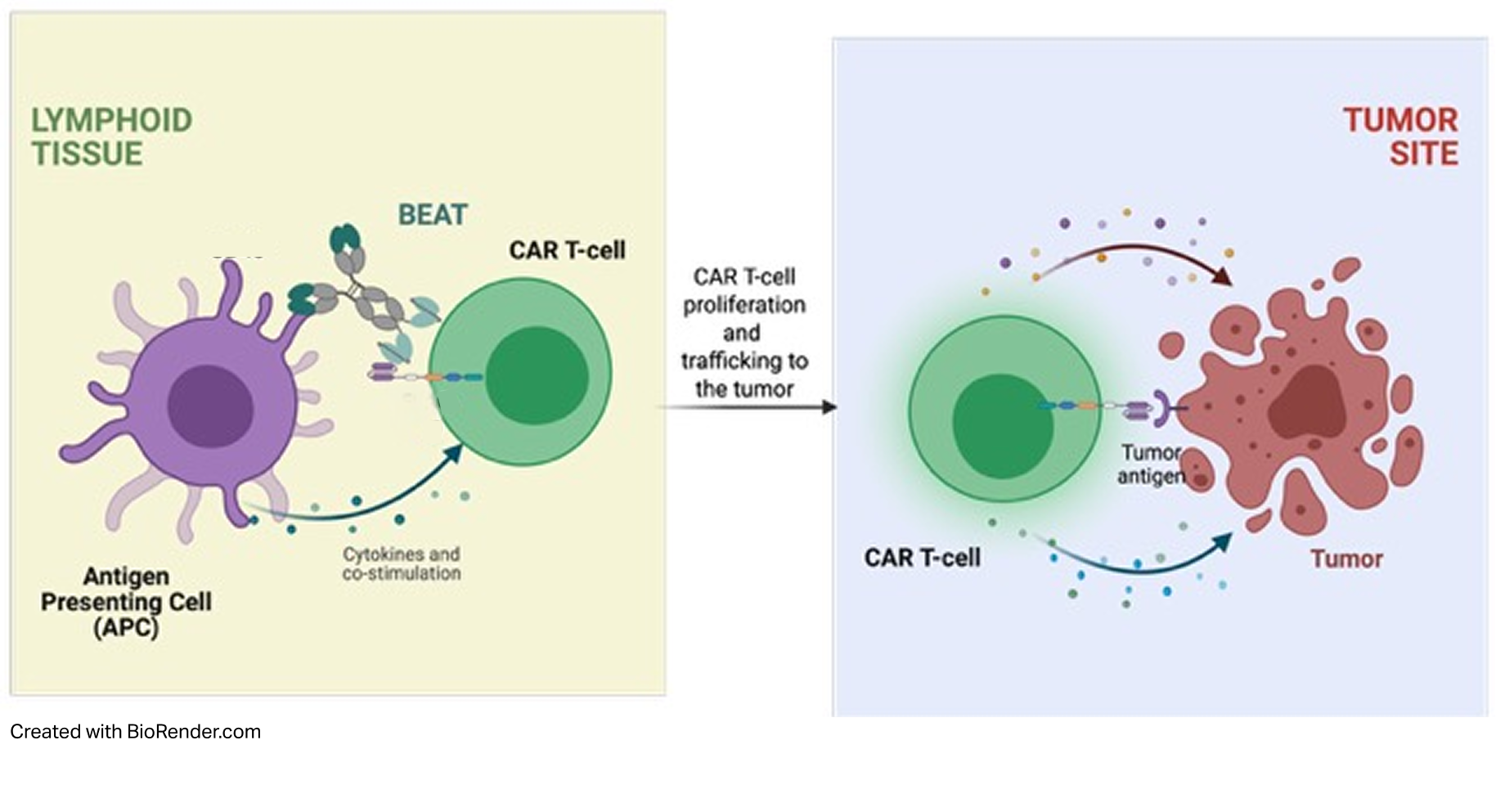
The Bispecific Engagers of Antigen Presenting Cells and T cells (BEAT) enable the CAR T-cell to engage with APCs in the lymph nodes, away from the suppressive tumour microenvironment.
With the BEAT engaging the APCs and the CAR T-cell therapy simultaneously, the CAR T-cell proliferated and expands in an immune supportive environment. The CAR T-cell gains the appropriate licensing and then leaves lymphoid tissues to effect the potent targeting of solid tumours.
In multiple preclinical models of solid tumours, the combination of the BEAT platform and CAR T-cell therapy has demonstrated strong CAR T-cell proliferation and persistence with CAR T-cell trafficking to, and infiltration of, large and established solid tumours.
Importantly, the BEAT drives potent CAR T-cell mediated anti-tumour efficacy and supports the generation of endogenous immunological responses including memory responses and epitope spreading to additional antigens, with resistance to both antigen-positive and antigen-negative tumour rechallenge.
The BEAT technology can be used with either autologous or in vivo CAR T-cell therapy to overcome the roadblocks seen with the treatment of solid tumours.